My child, it often happens that a man seeks ardently after something he desires and then when he has attained it he begins to think that it is not at all desirable; for affections do not remain fixed on the same thing, but rather flit from one to another. It is no very small matter, therefore, for a man to forsake himself even in things that are very small.
A man’s true progress consists in denying himself, and the man who has denied himself is truly free and secure.
—Thomas à Kempis, The Imitation of Christ
Category: AVARICE & ALMSGIVING & MINIMALISM
-
-
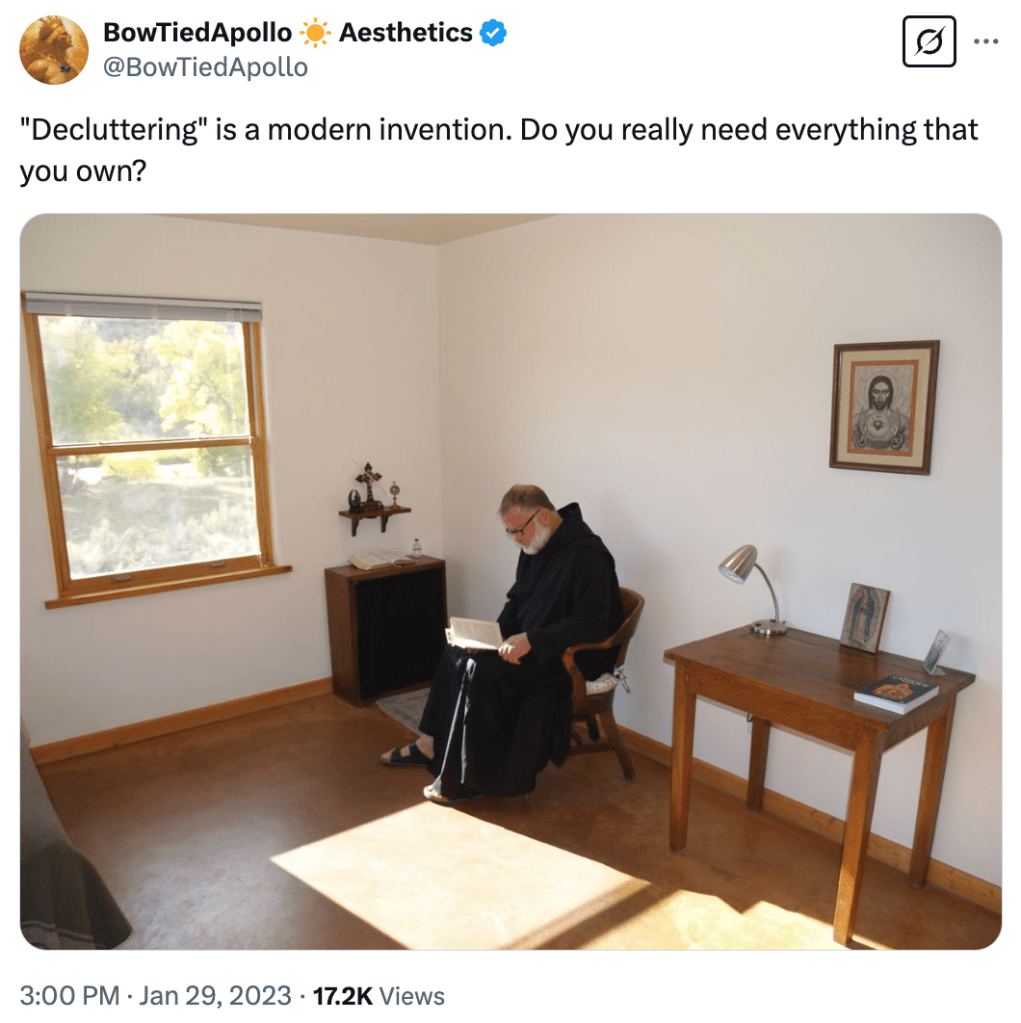
33. Discard any possessions that you can’t discuss with passion.
…As long as we stick to owning things that we really love, we aren’t likely to want more.
-
34. If you lost it [or it was ruined], would you buy it again?
A key way to gauge your passion for something you own is to ask yourself, “If I were to somehow lose this, would I want to buy it again?
-
When you reduce your possessions to a minimum, you have a clearer and better awareness of your desires. What are the things that are necessary and what are the things that you simply want? The line between these categories becomes clear, and it doesn’t apply only to objects. The same goes for our desire to eat. You can see what amounts of food are really necessary and the result is that you don’t eat more than you need to. Owning only the things that you need will hone your sense that this is enough for me, and you can be satisfied without having to eat huge amounts of food.
-
“It is better for you to be free of fear lying upon a pallet, than to have a golden couch and a rich table and be full of trouble.”
— Epicurus
-
We also fool ourselves with the stories we tell ourselves. When I was in my late teens, I wanted to own a Jeep. I imagined myself cruising around with the roof and doors off. I couldn’t imagine a cooler or more fun vehicle to own (with the exception of maybe a Corvette Stingray). An older friend of mine at the time, who had once owned a Jeep, told me “it’s more fun watching someone else drive a Jeep than it is to drive one yourself.” I later found out he was right.
-
The Diderot Effect
In the 18th century, the French philosopher Denis Diderot published “Regrets on Parting with My Old Dressing Gown.” An essay recounting when he received a scarlet gown from a friend as a gift. Upon receiving the gown he realized that the rest of his possessions seemed inferior by comparison.
“In its shelter I feared neither the clumsiness of a valet, nor my own, neither the explosion of fire nor the spilling of water. I was the absolute master of my old robe. I have become the slave of the new one.”
– Denis Diderot
He began to replace his belongings with those he felt were more suited to the higher caliber of his newly acquired gown. His straw chair was replaced with one made of leather; the wooden table for a nice bureau; and an empty space in the corner was filled with a brand new writing desk.
Wikipedia describes this process as “The introduction of a new possession that is deviant from the consumer’s current complementary goods can result in a process of spiraling consumption.”
Once we attain something of higher value, we then desire other things of higher value that compliment it. Such as when we buy a new house and feel the need to furnish it with new furniture and do away with our older, less aesthetically appealing furniture. We compare what we have and opt for the better option of the two (cycle of relativity).
Why We ‘Want’, and How To Want Less -
“A man can never learn what divine power is while he abides in comfort and spacious living.”
—St Isaac of Syria, Homily 72: On Faith and Humility -
“Appreciate without possessing.”
—Brittany Murphy
 SO GOOD QUOTES