Category: KNOWLEDGE & SELF-KNOWLEDGE

  • From The Screwtape Letters—a fictional work written from a senior demon’s perspective, advising a junior tempter.

    Keep everything hazy in his mind now, and you will have all eternity wherein to amuse yourself by producing in him the peculiar kind of clarity which Hell affords.

    The Screwtape Letters
    C. S. Lewis

  • From The Screwtape Letters—a fictional work written from a senior demon’s perspective, advising a junior tempter.

    And Nothing is very strong: strong enough to steal away a man’s best years not in sweet sins but in a dreary flickering of the mind over it knows not what and knows not why, in the gratification of curiosities so feeble that the man is only half aware of them, in drumming of fingers and kicking of heels, in whistling tunes that he does not like, or in the long, dim labyrinth of reveries that have not even lust or ambition to give them a relish, but which, once chance association has started them, the creature is too weak and fuddled to shake off.

    The Screwtape Letters
    C. S. Lewis

  • From The Screwtape Letters—a fictional work written from a senior demon’s perspective, advising a junior tempter.

    You must bring him to a condition in which he can practise self-examination for an hour without discovering any of those facts about himself which are perfectly clear to anyone who has ever lived in the same house with him or worked in the same office.

    The Screwtape Letters
    C. S. Lewis

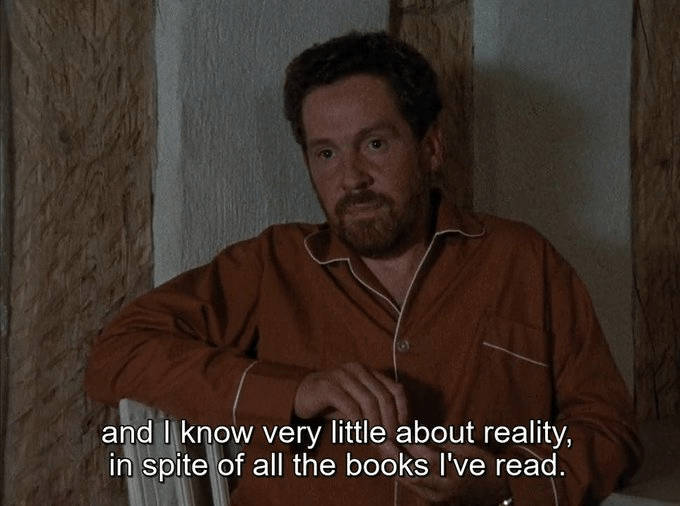
  • Because I am thinking so much about the past these days I have come to see that the past is always changing, is never static, never “placed” forever like a book on a shelf. As we grow and change, we understand things and the people who have influenced us in new ways.

    The House by the Sea: A Journal
    May Sarton

  • Scenes from a Marriage (1974)

  • O Lord, in your time and as you will, open to me the mystery of my innermost self, created in your Holy Image. Teach me too about the tendencies in me that distort that self.

    How to Be a Sinner
    Peter Bouteneff

  • They that are learned know the worth of time, and the manner how well to improve a day; and they are to prepare themselves for such purposes in which they may be most useful in order to arts or arms, to counsel in public, or government in their country: but for others of them that are unlearned, let them choose good company, such as may not tempt them to a vice, or join with them in any; but that may supply their defects by counsel and discourse, by way of conduct and conversation. Let them learn easy and useful things, read history and the laws of the land, learn the customs of their country, the condition of their own estate, profitable and charitable contrivances of it: let them study prudently to govern their families, learn the burdens of their tenants, the necessities of their neighbours, and in their proportion supply them, and reconcile their enmities, and prevent their law-suits, or quickly end them; and in this glut of leisure and disemployment, let them set apart greater portions of their time for religion and the necessities of their souls.

    —Rev. Jeremy Taylor, CARE OF OUR TIME. -Rules for employing our time…, The Whole Works of the Right Rev. Jeremy Taylor, Volume 3. THE RULE AND EXERCISES OF HOLY LIVING AND DYING….: The Rule and Exercises of Holy Living and Dying

  • The purely intellectual thinking that is void of the work of the Spirit does not produce contemplation… It might produce knowledge or philosophy, but not contemplation.

    There is a difference between a scholar and a worshipper, between the one who studies and the one who contemplates, between the one who searches the books and the one who receives from the Spirit.

    Contemplation is not just a thought. It is mixing the thought with the heart, then leaving the heart as a tool in the hand of the spirit. Then the spirit prays to take from the Spirit of God. And what the spirit takes is given to the mind through the heart.

    —H.H. Pope Shenouda III, The Spiritual Means

  • Some put in their mind a specific idea that they have already decided on, then read to search for a verse to confirm what they have made up their mind about. Or they try to subjugate what is written in the Bible to their own thoughts. As for you, do not be like that, but read to learn and to know.

    —H.H. Pope Shenouda III, The Spiritual Means

  • Perhaps you look too much inwards on self, instead of outwards on the Lord Jesus.—The healthiest people do not think about their health; the weak induce disease by morbid introspection. If you begin to count your heartbeats, you will disturb the rhythmic action of the heart. If you continually imagine a pain anywhere, you will produce it. And there are some true children of God who induce their own darkness by morbid self-scrutiny. They are always going back on themselves, analyzing their motives, re-considering past acts of consecration, or comparing themselves with themselves. In one form or another self is the pivot of their life, albeit that it is undoubtedly a religious life. What but darkness can result from such a course? There are certainly times in our lives when we must look within, and judge ourselves, that we may not be judged. But this is only done that we may turn with fuller purpose of heart to the Lord. And when once done, it needs not to be repeated. “Leaving the things behind” is the only safe motto. The question is, not whether we did as well as we might, but whether we did as well as we could at the time.

    We must not spend all our lives in cleaning our windows, or in considering whether they are clean, but in sunning ourselves in God’s blessed light. That light will soon show us what still needs to be cleansed away, and will enable us to cleanse it with unerring accuracy.

    The Gift of Suffering
    by F.B. Meyer