
Aggression, also found in the majority of neurotic states and in certain psychoses, can be connected with the passion of anger in the broader sense given to this term by the Fathers. Asthenia or lethargy, common to many mental diseases, corresponds rather exactly to one of the essential components of the passion of acedia. One can also perceive a direct connection between standard neurotic phobias, defined as ‘agonizing fears, with the passion of fear. The neurosis of anxiety can be easily classified within the framework of this same passion of fear and the passion of sadness. Psychotic depression has a connection on the one hand with acedia and on the other with despair, an extreme form of the passion of sadness.
Mental Disorders & Spiritual Healing: Teachings from the Early Christian East
Jean-Claude Larchet
Category: PSYCHOTHERAPY
-
-
Many psychiatrists recognize the fact that these medications are only adjuvants whose greatest value is to make the patient amenable to therapies based on psychological interventions, but such therapies are seldom used, while the medicinal approach is rarely crowned with success. One knows that psychoanalysis, one of the most elaborate forms of therapy currently available, rarely cures those afflicted with psychoses, and only attains to limited success with neuroses.
Mental Disorders & Spiritual Healing: Teachings from the Early Christian East
Jean-Claude Larchet -
“Everyone thinks that creativity and motivation come from tapping into your childhood issues and trauma. In fact they come from tapping into your childhood wonder and enthusiasm.”
—Gena Gorlin -
Therapy and Introspection: A Cultural Experiment
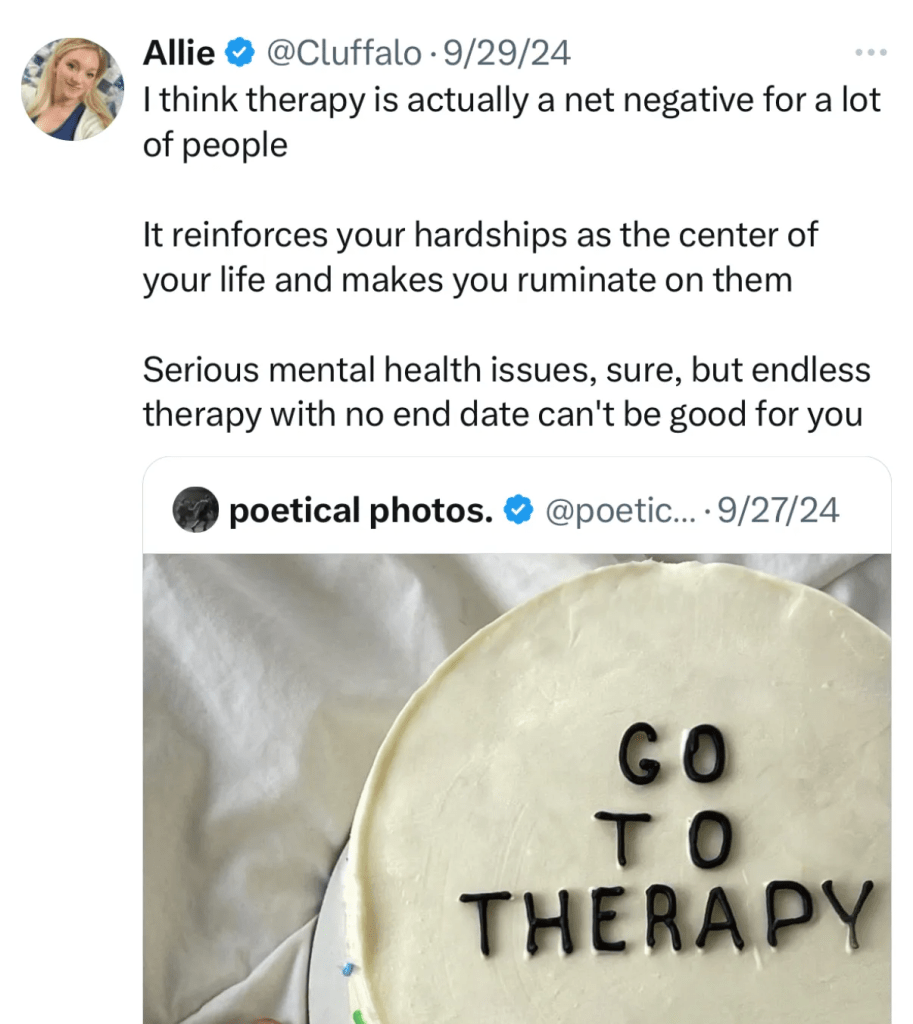
Therapy and deep introspection are new enough that we don’t fully understand their long-term impact on personal resilience or society’s mindset. In many ways, we’re experimenting with introspection as a tool, one that’s untested compared to the ancient preference for forward-focused living. -
But if going to therapy has taught me anything, it’s that nothing is actually solved by intellectualizing and pathologizing every part of what we feel — and when we try, we’re usually sort of wrong anyway. Your emotions, by and large, are not a problem to be fixed in service of producing a better, more manageable, more loveable self. They just want to be felt.
no good alone
rayne fisher-quann -
Many, if not most, alcohol and drug addicts eventually free themselves from the clutches of addiction on their own, without therapeutic help
Self-change from problems with alcohol and drugs: A scoping review of the literature since 2010
Florian De Meyer, Nellie Bencherif, Clara De Ruysscher, Lou Lippens, Wouter Vanderplasschen -
“Your mind is like an unsafe neighborhood; don’t go there alone,” explains Augusten Burroughs in Dry, his memoir about overcoming alcoholism. While therapy and coaching certainly makes braving “unsafe neighborhood” in our head easier, it can only go so far. It’s not like our therapist can actually climb inside our brain and evict all the bad guys. We can begin making the dangerous places in our mind safe again by choosing the right daily activities.
The Irresistible Introvert: Harness the Power of Quiet Charisma in a Loud World
Michaela Chung -
Many psychiatrists recognize the fact that these medications are only adjuvants whose greatest value is to make the patient amenable to therapies based on psychological interventions, but such therapies are seldom used, while the medicinal approach is rarely crowned with success. One knows that psychoanalysis, one of the most elaborate forms of therapy currently available, rarely cures those afflicted with psychoses, and only attains to limited success with neuroses.
Mental Disorders & Spiritual Healing: Teachings from the Early Christian East
Jean-Claude Larchet

 SO GOOD QUOTES