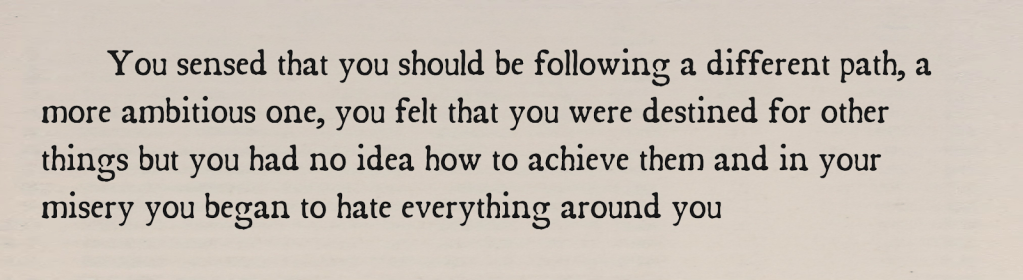
He shows that we can dissolve envy, just by bringing an end to comparing our life situation with that of others. The Bible is full of reminders that we are all called into different circumstances in life, and for different purposes of God. As the Lord has called each person, so let each person walk (I Cor. 7:17), says Scripture.
—Dee Pennock, God’s Path to Sanity
Category: VOCATION
-
-
We all have value.
We all contribute. We all give back—if not through paid work, then as part of the human ecosystem.
-
And you, therefore, if you stay in your house, if you are held fast in your bed, do not think that you are living an unproductive life.
For you are enduring something more grievous than what you have suffered at the hands of public torturers, by whom you have been dragged, savagely attacked, stretched to the utmost-and that is this extreme infirmity of yours, which is like having a public torturer continually residing in your house. But do not therefore either desire your end or neglect your health; for that is not safe. Therefore Paul heartily advises Timothy to take the greatest care of himself. But about your illness—it’s enough to say these things.
—Saint John Chrysostom, Letters to Saint Olympia
-
That it is our duty to perform each task considered as worthy with the utmost enthusiasm is insured by the terrible caveat that performing Godly work in a careless manner curses it. But worry, or the many worries that trouble the heart and give it no peace, is a disease of fallen man, who under took to decide his own fate and who is tossed and turned on all sides. Worry disturbs our thoughts and does not even allow us to focus on the task at hand. I suggest, therefore, that you look into this and, if you find that such a worry occasionally overwhelms you, try to drive it out and do not give it any ground. Have enthusiasm for your work and, performing it with utmost care, expect success from God, dedicating the task itself to Him, no matter how small it is, and you will get rid of worry.
Do this, and everyday occupations and tasks will not distract you from God.
May the Lord help you!
—St. Theophan the Recluse -
Our Longing for Home
IT is important to read Jesus’s parable of the lost son in the context of the whole of Luke, chapter 15, but the story has an eVen larger context. If we read the narratiVe in light of the Bible’s sweeping theme of exile and homecoming we will understand that Jesus has given us more than a moving account of individual redemption. He has retold the story of the whole human race, and promised nothing less than hope for the world.
In Jesus’s parable the younger brother goes off into a distant country expecting a better life but is disappointed. He begins to long for home, remembering the food in his father’s house. So do we all.
“Home” exercises a powerful influence oVer human life. Foreign-born Americans spend billions annually to visit the communities in which they were born. Children who neVer find a place where they feel they belOng carry an incapacity for attachment into their adult lives. Many of us have fond memories of times, people, and places where we felt we were truly home. However, if we ever have an opportunity to get back to the places we remember so fondly, we are usually disappointed. For thirty-nine years my wife, Kathy, spent summers with her family in a ramshackle cottage on the shores of Lake Erie. The very memory of that place is nourishing to Kathy’s spirit. But returning to the actual, now-dilapidated property is a gut-wrenching experience. It won’t be much different if someone buys it and puts up new condos on it. An actual visit to the place will always present her with a sense of loss.
Home, then, is a powerful but elusive concept. The strong feelings that surround it reveal some deep longing within us for a place that absolutely fits and suits us, where we can be, or perhaps find, our true selves. Yet it seems that no real place or actual family ever satisfies these yearnings, though many situations arouse them. In his novel A Separate Peace, John Knowles’s central character discovers that Summer mornings in New Hampshire give him “some feeling so hopelessly promising that I would fall back in my bed to guard against it . . . I wanted to break out crying from stabs of hopeless joy, or intolerable promise, or because those mornings were too full of beauty for me.” In East of Eden, John Steinbeck similarly says of the mountains of central California that he wanted “to climb into their warm foothills almost as you want to climb into the lap of a beloved mother.”
The memory of home seems to be powerfully evoked by certain sights, sounds, and even smells. But they can only arouse a desire they can’t fulfill. Many of the people in my church have shared with me how disappointing Christmas and Thanksgiving are to them. They prepare for holidays hoping that, finally, this year, the gathering of the family at that important place will deliver the experience of warmth, joy, comfort, and love that they want from it. But these events almost always fail, crushed under the weight of our impossible expectations.
There is a German word that gets at this concept— the word Sehnsucht. Dictionaries will tell you that there is no simple English synonym. It denotes profound homesickness or longing, but with transcendent overtones. The writer who spoke most of this “spiritual homesickness” was C. S. Lewis, in his famous sermon “The Weight of Glory.” He refers to many similar experiences like those described by Steinbeck and Knowles, and then he says:
Our commonest expedient is to call it beauty and behave as if that had settled the matter. Wordsworth’s expedient was to identify it with certain moments in his own past. But all this is a cheat. If Wordsworth had gone back to those moments in the past, he would not have found the thing itself, but only the reminder of it; what he remembered would turn out to be itself a remembering. The books or the music in which we thought the beauty was located will betray us if we trust to them; it was not in them, it only came through them, and what came through them was longing. These things—the beauty, the memory of our own past—are good images of what we really desire; but if they are mistaken for the thing itself they turn into dumb idols, breaking the hearts of their worshippers. For they are not the thing itself. . . . Now we wake to find . . . we have been mere spectators. Beauty has smiled, but not to welcome us; her face was turned in our direction, but not to see us. We have not been accepted, welcomed, or taken in. . . . Our life-long nostalgia, our longing to be reunited with something in the universe from which we feel cut off, to be on the inside of some door which we have always seen from the outside, is no mere neurotic fancy, but the truest index of our real situation.
There seems to be a sense, then, in which we are all like the younger brother. We are all exiles, always longing for home. We are always traveling, never arriving. The houses and families we actually inhabit are only inns along the way, but they aren’t home. Home continues to evade us.
Timothy Keller, The Prodigal Son
-
We seldom fully realize that we are sent to fulfill God-given tasks. We act as if we have to choose how, where, and with whom to live. We act as if we were simply dropped down in creation and have to decide how to entertain ourselves until we die. But we were sent into the world by God, just as Jesus was. Once we start living our lives with that conviction, we will soon know what we were sent to do. These tasks may be very specialized, or they may be the general task of loving one another in everyday life.
—Henri Nouwen, Discernment: Reading the Signs of Daily Life -
From the beginning, two inner voices have been speaking to me: one saying, “Henri, be sure you make it on your own. Be sure you become an independent person. Be sure I can be proud of you,” and another voice saying, “Henri, whatever you are going to do, even if you don’t do anything very interesting in the eyes of the world, be sure you stay close to the heart of Jesus; be sure you stay close to the love of God.”
—Henri Nouwen, Discernment: Reading the Signs of Daily Life -
Such depth of loneliness cannot be understood or communicated but it can be shared…He resolved if he came out alive to devote himself to good and creative works.
—Clark E. Moustakas, Loneliness