Clement of Alexandria furthers this notion by indicating that rewards in the afterlife will be dependent in part on one’s underlying motivation for why they performed any work for God: The same work, then, is different, depending on what prompted it. Was it because of fear, or was it accomplished because of love, faith, or knowledge? Rightly, therefore, their rewards are different.
Orthodox Afterlife
John Habib
Category: VOCATION
-
-
We should not think too much about who our superiors are, or who our employer is. What we should bear in mind is that every type of work on earth and in all the universe is God’s work, and as such it should be performed from the heart, without reservation. When we do so, we can free ourselves from our interior resistance. Every action of ours will then help our neighbor, beginning with our family, wherever we may be. So we must always be sincere. Then we radiate peace, quiet, and love, and we are loved in return. With our thoughts we either attract or repel enemies, friends, family, and neighbors. However, people usually take this lightly and suffer a lot as a result.
—Elder Thaddeus of Vitovnica -
If some are still dominated by their former bad habits, and yet can teach by mere word, let them teach. But they should not have authority as well. For, perhaps, being put to shame by their own words, they will eventually begin to practise what they preach. And even if they do not begin, yet they may be able to help, as I saw happen with others who were stuck in the mud. Bogged down as they were, they were telling the passers-by how they had sunk there, explaining this for their salvation, so that they should not fall in the same way. However, for the salvation of others, the all-powerful God delivered them too from the mud. But if those who are possessed by passions voluntarily plunge into pleasures, let them teach by silence; for Jesus began both to do and to teach.
—St. John Climacus,The Ladder of Divine Ascent -
A person who through the grace of God partakes of divine blessings is under an obligation to share them ungrudgingly with others. For Scripture says, ‘Freely you have received, freely give’ (Matt. 10:8). He who hides the gift in the earth accuses the Lord of being hard-hearted and mean (cf. Matt. 25:24), and in order to spare the flesh he pretends to know nothing about holiness; while he who sells the truth to enemies, and is then revealed as avid for self-glory, hangs himself, unable to bear the disgrace (cf. Matt. 26:15; 27:5).
-
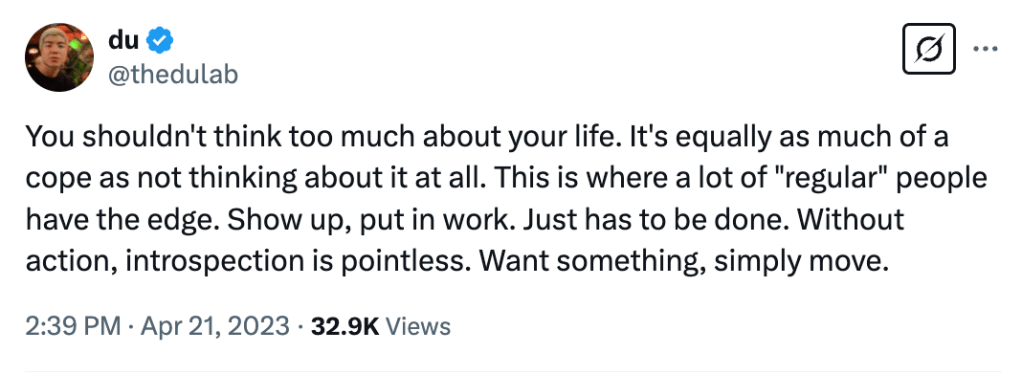
What I really need is to get clear about what I must do, not what I must know, except insofar as knowledge must precede every act. What matters is to find a purpose, to see what it really is that God wills that I shall do; the crucial thing is to find a truth which is truth for me, to find the idea for which I am willing to live and die.
-
It is not so difficult to see that, in our particular world, we all have a strong desire to accomplish something. Some of us think in terms of great dramatic changes in the structure of our society. Others want at least to build a house, write a book, invent a machine, or win a trophy. And some of us seem to be content when we just do something worthwhile for someone. But practically all of us think about ourselves in terms of our contribution to life. And when we have become old, much of our feelings of happiness or sadness depend on our evaluation of the part we played in giving shape to our world and its history. As Christians, we even feel a special call to do something good for someone: give advice, cast out a devil or two, and maybe even preach the good news from place to place.
But although the desire to be useful can be a sign of mental and spiritual health in our goal-oriented society, it can also become the source of a paralyzing lack of self-esteem. More often than not, we not only desire to do meaningful things, but we often make the results of our work the criteria of self-esteem. And then we not only have successes, we become our successes. When you are in the habit of giving speeches in this country, you find that the older you get, the longer your introducers speak, since they feel obligated to list all your accomplishments from your college days to the present.
When we start being too impressed by the results of our work, we slowly come to the erroneous conviction that life is one large scoreboard where someone is listing the points to measure our worth. And before we are fully aware of it, we have sold our soul to the many grade-givers. That means we are not only in the world, but also of the world. Then we become what the world makes us. We are intelligent because someone gives us a high grade. We are helpful because someone says thanks. We are likable because someone likes us. And we are important because someone considers us indispensable. In short, we are worthwhile because we have successes. And the more we allow our accomplishments—the results of our actions—to become criteria of our self-esteem, the more we are going to walk on our mental and spiritual toes, never sure if we will be able to live up to the expectations which we created by our last successes. In many people’s lives, there is a nearly diabolic chain in which their anxieties grow according to their successes. This dark power has driven many of the greatest artists into self-destruction.
—Henri Nouwen, Out of Solitude: Three Meditations on the Christian Life
-
“How will I find the right books to give me the answers I want, and even if I ever find them, when will I get time to read them?”
—St. Augustine -
If your mood and motivation are low, are telling you not to act, that’s all the more reason to act. Yes, feeling good can lead to action, but action can also lead to feeling good.
—Brad Stulberg